A social media audit before Q4 is how you find what is working, cut what is quietly wasting budget, and decide where next quarter’s dollars should actually go before the calendar locks in. Run it in Q3, look at all four channels together (organic social, UGC, influencer, and email), and turn the findings straight into your Q4 content calendar and spend. Skip it and you head into the highest-spend quarter of the year funding assumptions that are already months old.
Consider this our most lukewarm take yet… your Q4 planning should start in Q3. And this doesn’t just entail mapping out your promotions.
In our experience, plenty of brands are working off assumptions that are months old by the time they start Q4 planning. The content calendar that worked in Q2 gets copy-pasted forward. The platform strategy that made sense last spring gets funded again. Then Q4 hits, and brands find out the hard way that what used to work no longer works.
And hey, maybe this strategy is doing a decent job, but is it truly optimizing your ROI and overall revenue during the highest-spend, highest-scrutiny quarter of the year?
It doesn’t have to be this way, and we make sure it doesn’t for our clients. We run strategic social media audits for our clients ahead of Q4 planning so we can assess what's earning attention, what's quietly burning budget, and where the next quarter's dollars should actually go.
If you're heading into Q4 planning without a social media audit, here's the exact framework we use with our own clients!
Why a Pre-Q4 Audit Matters More Than Any Other Time of Year
Algorithm shifts happen quarterly. What performed in your summer content mix can quietly underperform by fall. Platforms change how they distribute content more often than most marketing teams update their strategy to match.
Q3 is the last real checkpoint before budgets lock in. Once the Q4 calendar and ad spend get finalized, there's little room to course-correct. An audit now is the difference between funding what's working and funding what used to work.
Competitive pressure spikes. Gifting content, holiday promos, and end-of-year sales push every brand in your category to show up louder. You need a clear read on where you actually stand before that noise starts.
The 7-Part Social Media Audit Checklist
Platform-by-platform performance review: Don't just look at totals; look at the trends. We’re talking engagement rate, reach, and follower growth over the last 90 days, not the last 12 months. A format that grew steadily through spring but has flatlined since summer needs a different strategy than one still climbing.
Content format audit: Break down performance by format. Reels and short-form video vs. static posts vs. carousels. Look at video completion rate, not just views. This is usually where the clearest "stop doing this, start doing that" signal lives.
When we ran this audit forMom Water, the data pointed hard toward short-form video — the resulting content racked up nearly 500K TikTok views in the first month alone, 30.9K likes, and 5,363 shares.
UGC and influencer content effectiveness: Compare how creator-led content performs against branded content. If UGC is consistently outperforming your polished assets, that's not a coincidence; it's a strategy signal. In our opinion, the perfect mix is the key to unlocking new heights in your social media strategy.
This is exactly what we found auditingMeUndies' content mix — leaning into lo-fi, shareable UGC over polished assets drove engagement up 223% and shares up 506% in the first month alone, with 913K+ views by month three.
Audience and community health check: Read your comments. Check DM volume. Are people talking to your brand, or are you just talking at them? Sentiment tells you more about brand health and consumer intent than reach ever will.
Competitive benchmarking: Where are competitors capturing attention you're not? This isn't about copying their content; it's about identifying the gaps in your own strategy that their performance is exposing.
Owned vs. earned distribution mix: How much of your reach depends on paid boosting versus organic, shareable content? Heavy paid dependency is a budget risk heading into the most expensive ad quarter of the year.
Cross-channel consistency: Does your social messaging match your email messaging, and does your email messaging match your on-site content? Misaligned messaging across channels confuses the exact audience you're trying to convert in Q4.
For our clientDetoxU, aligning email automations, weekly newsletters, organic social, and UGC into one cohesive ecosystem drove an average email open rate of 60% — a direct result of treating the channels as one strategy instead of several disconnected ones.
What We Look For When We Audit a Client's Social Presence
A useful audit isn't a 40-slide report nobody reads. It's a working outline that directly shapes the next quarter's content calendar and budget.
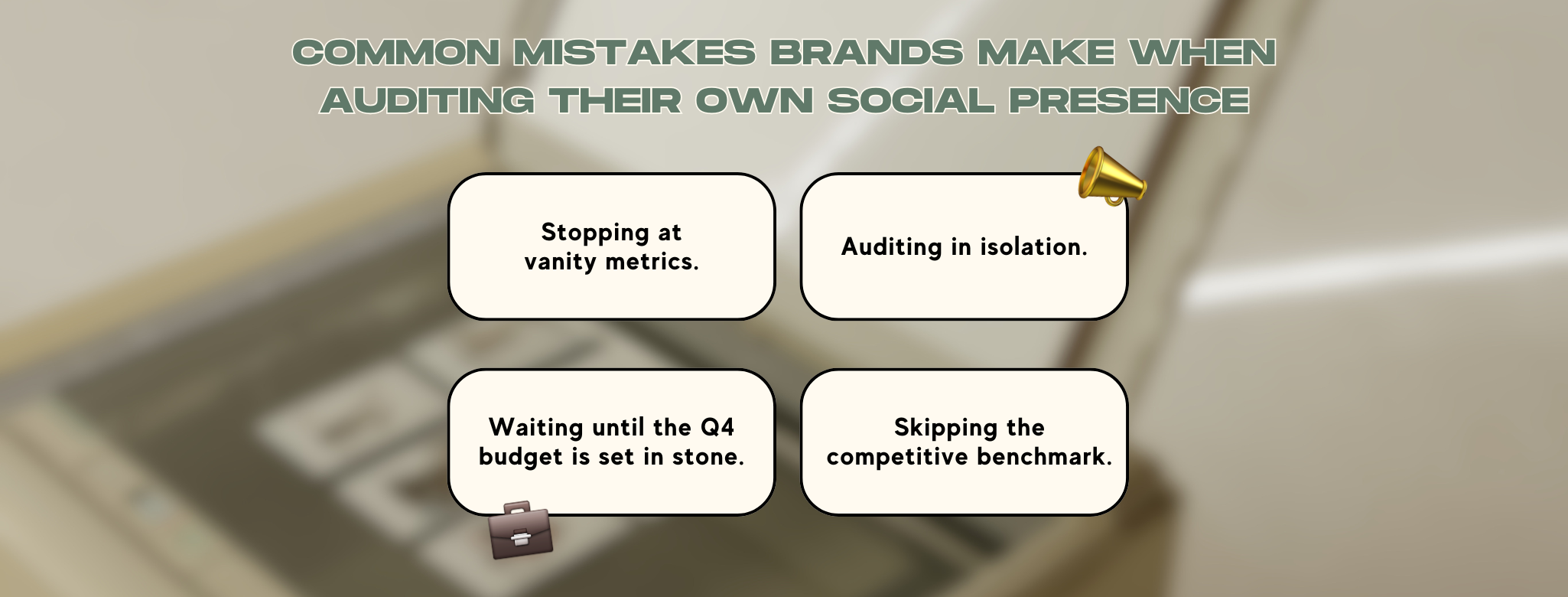
As a boutique agency working across organic social, UGC, influencer management, and email, we look at the whole ecosystem when we audit an account. Not just one platform in isolation. A brand can be winning on TikTok and quietly losing ground in email at the same time, and if you only audit the channel that's making noise, you miss the one that's actually leaking revenue.
How Often Should You Run a Social Media Audit?
To ensure your social media strategy is always running in tip-top shape, we recommend running a social media audit quarterly at a minimum. When approaching a high-spend season like Q4, it's worth running a focused audit even if your last full one was recent. The goal isn't to audit constantly; it's to make sure no major budget decision gets made on stale data.
An audit only matters if it actually changes what happens next. If it's not directly informing your content calendar and budget for the next 90 days, it's just a report.
It’s no secret that Q4 is the busiest season of the year, and our roster of industry-leading clients fills up fast. Secure your spot with our expert team and inquire today! Browse more of our recent client work to see what an audit-driven strategy actually looks like in practice.
Frequently Asked Questions
What is a social media audit and what should it cover?
A social media audit is a structured review of how your channels are actually performing against your goals. A strong one covers platform-by-platform trends, content format performance, UGC and influencer effectiveness, audience sentiment, competitive gaps, your paid-versus-organic mix, and cross-channel consistency. The point is not the report itself. It is a clear set of decisions about what to keep funding, what to cut, and what to test next.
When should a brand run a social media audit before Q4?
Run it in Q3, before your Q4 calendar and ad budget are locked. Q3 is the last checkpoint where findings can still change how you spend. If you wait until Q4 is already underway, you are course-correcting mid-flight during the most expensive and competitive quarter of the year.
How often should you run a social media audit?
Quarterly at a minimum for most brands. High-spend seasons like Q4 or a major launch warrant a focused audit even if your last full one was recent. The goal is simply to make sure no big budget decision rests on data that is months out of date.
What metrics matter most in a social media audit?
Trends beat totals. Look at engagement rate, reach, and follower growth over the last 90 days rather than lifetime numbers, and study video completion rate instead of raw views. On the community side, comment quality and DM volume reveal buying intent that reach alone will never show you.
Do I need to audit email too, or just social?
Audit email alongside social. Brands often win on one channel while quietly losing revenue on another, and email is frequently the one leaking. Treating organic social, UGC, influencer, and email as one connected ecosystem is what turns an audit into real growth, which is how we drove a 60% average open rate for DetoxU.
Can I run a social media audit myself, or should I hire an agency?
You can run a basic audit in-house if you have the time and a clear framework, and this checklist gives you one. Where an agency earns its keep is pattern recognition across many brands and the ability to turn findings into an executed plan, not just a document. If your team is stretched thin heading into Q4, that is usually the moment to bring in help.
Author: Becca Bunch, Founder and CEO of Homemade Social. Becca has worked in social media since 2012 and founded Homemade Social in Phoenix, Arizona. She has been featured on Channel 3 News and Create & Cultivate and was named a "modern social media queen" by AZ Foothills.
About Homemade Social: Homemade Social is a white-glove boutique digital marketing agency in Phoenix, Arizona serving beauty, wellness, food, and beverage brands. Services include organic social media management, content creation and UGC, influencer management, and email marketing.